

English English

MENU

2 minute read

VDA 4938 - the new standard for electronic invoices in the automotive industry

Background of VDA and electronic invoicing

The German Association of the Automotive Industry (VDA) has for many years been publishing standards for processes found in the automotive and associated industries. VDA is the acronym of the association’s German name Verband der Deutschen Automobilindustrie.

VDA has also, in addition to standards for logistics such as delivery call-offs, JIT delivery schedules, despatch advices, etc., published standards for electronic invoicing. The two familiar standards are VDA 4906 (EDI for invoices) and VDA 4908 (EDI for credit notes). Both standards are outdated today. VDA 4906 was passed in May 1993 and VDA 4908 in May 1996. The use of these standards is no longer recommended and the new e-invoicing standard VDA 4938 should be used instead.

White Paper - E-invoicing in Europe

VDA 4938 – a standard for electronic invoicing

VDA developed the VDA 4938 standard to meet current statutory and fiscal requirements for the automotive industry. The objective of VDA 4938 is a uniform design of electronic invoices and credit notes to allow the electronic exchange of information between companies using EDI (OEMs and tier suppliers etc.).

The VDA 4938 standard has four different parts, as listed below.
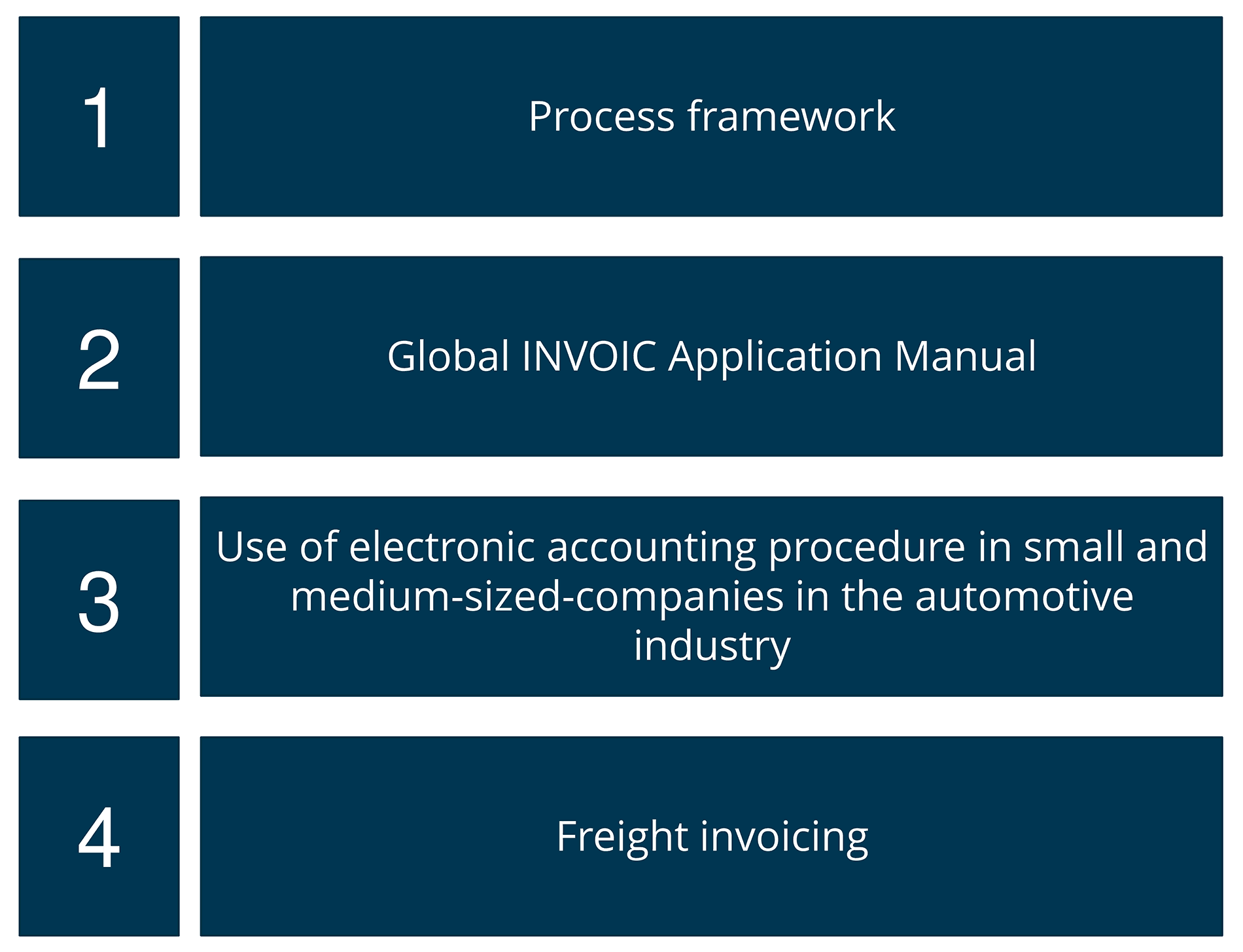

Overview of the VDA 4938 family of standards

The individual documents are available under the following links (in German):

  • 4938 T1 – Process framework for the exchange of electronic accounting documents, using EDIFACT without digital signatures
  • 4938 T2 – V 2.2 Global INVOIC Application Manual
  • 4938 T3 – Use of electronic accounting procedures for small and medium-sized companies in the automotive industry
  • 4938 T4 – Freight invoicing

Part 1 deals with the process framework for electronic invoicing. This includes a process recommendation, technical guidelines, and guidelines for the involvement of service providers. Agreement templates and checklists for VDA 4938 users are also included.

Part 2 contains the EDI definition, the so-called EDIFACT Message Implementation Guideline – MIG for short, based on EDIFACT INVOIC D07A.

Part 3 contains the invoicing specification developed by auto-gration, an EU-funded project aimed at supporting small and medium-sized enterprises in their participation in global automotive industry supply chains. The result of this project is an XML specification for electronic invoicing, now included as Part 3 of VDA 4938.

Part 4 contains specifications for the display of freight invoices based on EDIFACT INVOIC D13A.

Any questions?

You have further questions in regard to VDA standards, or would you like to introduce a VDA 4938 based solution? Please do contact us or use our chat — we’re more than happy to help!

most read

Keep on reading

8 minute read

E-invoicing (and e-reporting) in Croatia: A Guide to Fiscalisation 2.0

From January 2026, Croatia mandates domestic B2B e-invoicing under Fiscalisation 2.0, alongside new fiscalisation and e-reporting obligations. This guide explains how the system works in practice, what businesses must prepare...

9 minute read

Serbia’s E-invoicing and E-transport Requirements Explained

In this article we explore Serbia e-invoicing and e-transport requirements, including who’s affected, key deadlines, and how to stay compliant.

7 minute read

Australia E‑invoicing: Rules, Formats and Timelines

Learn how Australia e‑invoicing works via Peppol, who must comply, required IDs, formats (PINT A‑NZ) and how to connect through accredited access points.

8 minute read

Peru E-invoicing Explained: What Businesses Need to Know

Your guide to e-invoicing in Peru. Learn how the system works, key SUNAT requirements, and what enterprises need to stay compliant.

6 minute read

Peppol Corner Models Explained

Learn how and why Peppol’s network architecture has evolved to the current five-corner model.

8 minute read

21 Must-Ask E-invoicing RFP Questions

Explore our helpful list of e-invoicing RFP questions to ask and learn what to look for when evaluating e-invoicing vendors.

7 minute read

Simplifying e-invoicing compliance: a practical approach

Simplify e-invoicing compliance with scalable strategies that cut risk, reduce manual work, and ensure audit-ready invoicing at scale.

6 minute read

Continuous transaction controls (CTCs) and real-time tax reporting

In this article, we break down what CTCs are, the challenges and benefits they present, and what businesses can do to stay ahead of the curve.

12 minute read

E-invoicing in Mexico: A Quick Guide to CFDI Compliance

Discover how E-invoicing in Mexico works and what CFDI compliance requires. Learn key rules for e-invoicing compliance in Mexico and how to stay audit-ready.

11 minute read

E-invoicing tools to simplify connector setup with self-service

Learn why setting up e-invoicing protocol connectors is so challenging and how ecosio’s self-service e-invoicing tools simplify the process.

7 minute read

ecosio Insights: E-invoicing Mandates and the Growth of B2B Process Automation

How will e-invoicing evolve in the years ahead? We sat down with e-invoicing expert Chris Newman to hear his thoughts about current trends.

6 minute read

ecosio Insights: VAT Compliance

In this interview, indirect tax expert Gunjan Tripathi shares her thoughts regarding the future of VAT compliance and reporting.

1

Looking for something? 👀

E-invoicing essentials survival pack

Everything you need to know about e-invoicing in one place, including:

  • Detailed regulation
    breakdowns
  • Popular webinar recordings
  • Insightful white papers
  • Helpful Q&A videos
WHITE PAPER

EDI in the Engineering Industry

Discover the secrets to B2B integration success with our comprehensive white paper

WHITE PAPER

EDI in the Automotive Industry

Discover the secrets to B2B integration success with our comprehensive white paper