
English English

MENU

2 minute read

What is a Core Invoice Usage Specification (CIUS)

European e-invoicing norm EN 16931-1

The European e-invoicing norm EN 16931-1 was developed by the EU member states in accordance with the EU directive 2014/55/EU. The norm EN 16931-1 represents a semantic data model of an invoice’s core elements. This means that the requirements for the most important elements of an invoice are defined in a syntax-independent form. In other words, the norm EN 16931-1 is essentially a PDF document, in which the invoice requirements are described in a readable language and independently from the syntax.

In addition you will find conversions in the technical syntaxes, based on UBL (Universal Business Language) and CII (Cross Industry Invoice).

Philip Helger, who co-wrote the European norm, offers a good overview of the components of the EN 16931 on his website. Unfortunately the norm itself is not available publicly, but needs to be purchased.

Core invoice usage specification

The semantic data model EN 16931-1 can include more data elements and definitions than required in certain situations or applications. Furthermore, there is often a requirement, where some elements of the norm are not optional but mandatory.
White Paper - 7 Mistakes EDI Solution Buyers Make

This is where Core Invoice Usage Specification (CIUS) is used to further define this invoicing norm base.

A CIUS example

The Republic of Austria has defined their own CIUS for e-invoices sent to the Austrian authorities. This CIUS is called CIUS-AT-NAT Austrian National Core Invoice Usage Specification and limits the extent of both EU invoice syntaxes UBL and CII.

Those looking for information on how to create and process UBL documents with attachments in SAP can find our article “Create and Process UBL Documents with Attachments in SAP” on this topic. 
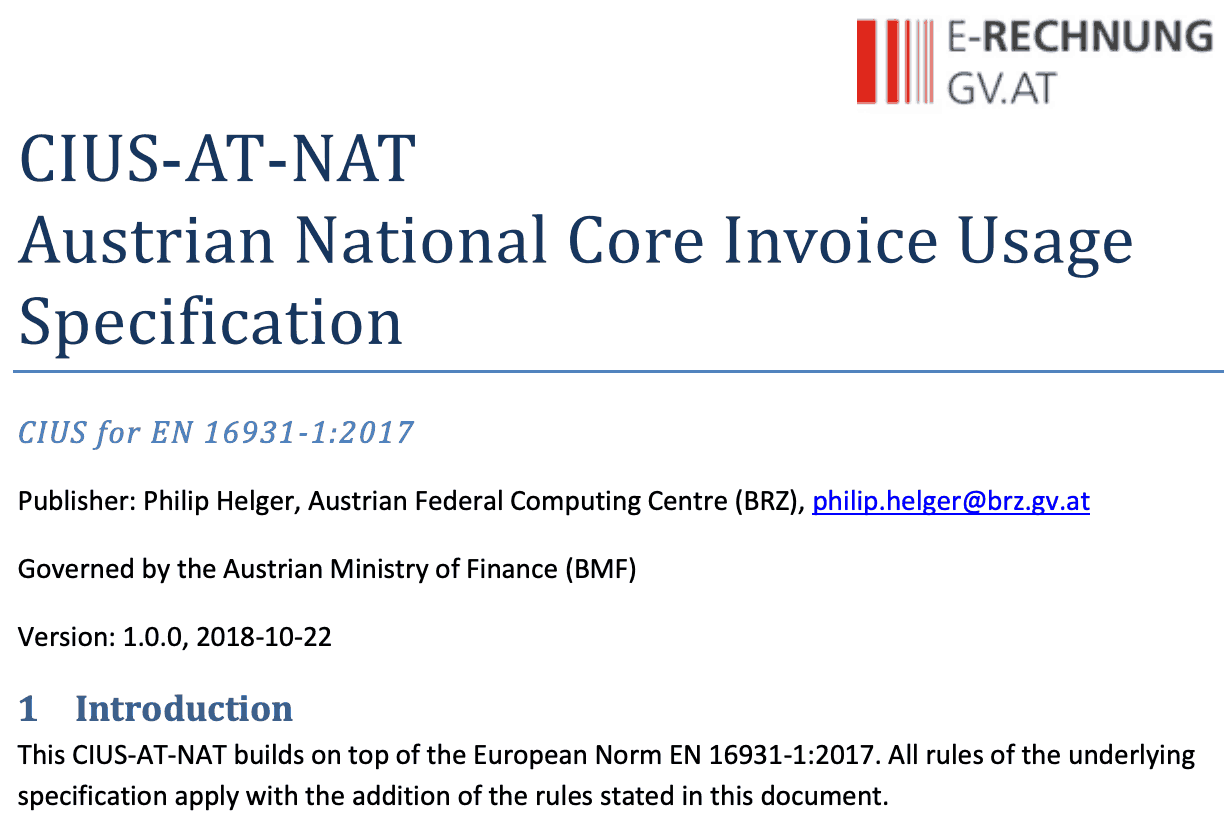

Example of an Austrian CIUS

You can access the Austrian CIUS at the following link.

Do you have any questions?

Do you still have questions about e-invoices? Feel free to contact us, we would love to help you!


SAP ERP and SAP S/4HANA are the trademarks or registered trademarks of SAP SE or its affiliates in Germany and in several other countries. 
Subjects

most read

Keep on reading

12 minute read

E-invoicing in Poland: 7 topics you need to know in 2026

E-invoicing in Poland is moving to mandatory KSeF clearance in 2026. Key dates, formats, and steps to prepare for compliance.

10 minute read

Taiwan e‑invoicing (eGUI) explained: what businesses need to know

Taiwan e‑invoicing (eGUI) is mandatory for B2B and B2C. This Taiwan e‑invoicing guide explains key rules, deadlines and integration options for businesses.

1 minute read

Singapore e-invoicing: a complete guide for businesses

Discover how Singapore’s GST InvoiceNow requirement works, who’s in scope, which documents are affected and how to comply via InvoiceNow, PINT SG and IMDA‑accredited Access Points.

1 minute read

Everything you need to know about e‑invoicing in New Zealand

If you invoice New Zealand government agencies, you need to be ready for Peppol e‑invoicing. New Zealand is steadily building a digital economy where invoices move as structured data, not...

8 minute read

E-invoicing (and e-reporting) in Croatia: A Guide to Fiscalisation 2.0

From January 2026, Croatia mandates domestic B2B e-invoicing under Fiscalisation 2.0, alongside new fiscalisation and e-reporting obligations. This guide explains how the system works in practice, what businesses must prepare...

9 minute read

Serbia’s E-invoicing and E-transport Requirements Explained

In this article we explore Serbia e-invoicing and e-transport requirements, including who’s affected, key deadlines, and how to stay compliant.

7 minute read

Australia E‑invoicing: Rules, Formats and Timelines

Learn how Australia e‑invoicing works via Peppol, who must comply, required IDs, formats (PINT A‑NZ) and how to connect through accredited access points.

8 minute read

Peru E-invoicing Explained: What Businesses Need to Know

Your guide to e-invoicing in Peru. Learn how the system works, key SUNAT requirements, and what enterprises need to stay compliant.

6 minute read

Peppol Corner Models Explained

Learn how and why Peppol’s network architecture has evolved to the current five-corner model.

6 minute read

How to Build a Successful E-invoicing Request For Proposal (RFP)

Learn what crafting an effective e-invoicing request for proposal (RFP) involves and how to master the RFP process.

8 minute read

21 Must-Ask E-invoicing RFP Questions

Explore our helpful list of e-invoicing RFP questions to ask and learn what to look for when evaluating e-invoicing vendors.

7 minute read

Simplifying e-invoicing compliance: a practical approach

Simplify e-invoicing compliance with scalable strategies that cut risk, reduce manual work, and ensure audit-ready invoicing at scale.

1

Looking for something? 👀

🚨 Vos questions sur la réforme, nos réponses en direct

Participez à une session interactive dédiée à la facturation électronique en France. Nos expertes ecosio répondent à vos questions en temps réel.
Mardi 17 mars 2026 · 11h (CET) · 40 min