




France’s e-invoicing and e-reporting reform (facturation électronique en France) has been on the runway for a while. Now, with the pilot officially launching and fresh clarification in the Finance Law 2026, it’s starting to feel like the countdown is real.
If you operate in France, e-invoicing and e-reporting in France is no longer a distant compliance topic. With the facturation électronique en France rapidly approaching, it is becoming an operational reality that needs decisions, testing, and a platform partner you can rely on.
Looking to stay up-to-date with French regulations?
Our e-invoicing in France country page is constantly updated to reflect the latest requirements
TL;DR Summary
- France’s e-invoicing mandate requires immediate action, with receiving obligations starting September 2026
- It reshapes invoicing operations through accredited platforms, not just new formats
- Delayed preparation creates major operational risks across ERP, data, and partner processes
- The pilot phase is key to testing real workflows and avoiding disruption at go-live
- Choosing the right platform is critical for long-term compliance, stability, and scalability
What is the France e-invoicing mandate?
In French, this programme is commonly referred to as facturation électronique en France. It is also increasingly described as facturation électronique obligatoire, because it becomes a legal requirement in phased steps.
The France e-invoicing mandate is the national reform that will require VAT-registered businesses established in France to exchange domestic B2B invoices electronically through an accredited ecosystem, and it also introduces e-reporting in France requirements, where e-reporting covers B2C and certain cross-border transactions and, in some cases, payment data, when those flows sit outside the e-invoicing scope.
This matters because it changes how invoices flow between trading partners. It is not simply a requirement to generate a new file format. Instead, France is establishing a controlled platform model, where your invoicing operations will run through an accredited provider.
B2B e-invoicing France = domestic B2B between VAT-registered entities established in France.
E-reporting France = B2C and cross-border reporting, and it includes transaction and payment data.
A quick note on terminology: PDP vs PA
If you have been tracking the réforme facturation électronique 2026, you may have seen the term PDP (plateforme de dématérialisation partenaire).
In current communication, PDPs are referred to as PA, meaning an accredited platform or plateforme agréée. In plain terms, your PA is the plateforme that connects you to the ecosystem and the central government infrastructure.
The “Y-model” in plain language
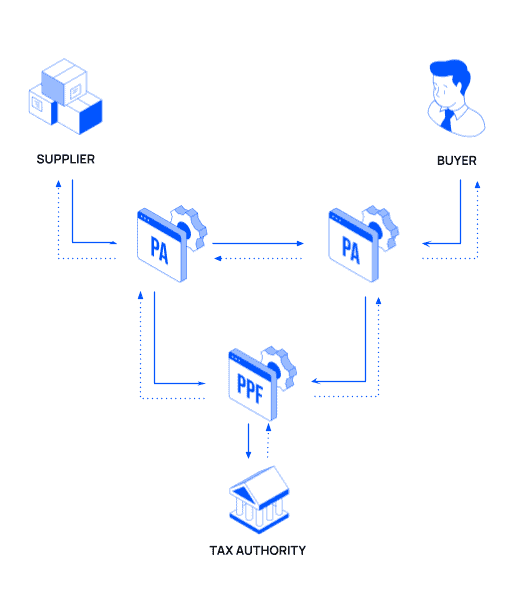
France’s B2B e-invoicing and e-reporting model is often described as a “Y-model”. In practice, it means:
- Businesses send and receive invoices through an accredited platform (PA – approved plateforme agréé facture électronique (PA)
- The PPF France (Portail Publique de Facturation) acts as the central backbone, running the annuaire facture électronique (the central directory for routing) and concentrating the required tax data
- The sender and receiver PAs connect between each other to exchange e-invoices as well as with the PPF to report invoice data and related payment data
- Chorus Pro remains the B2G gateway, and under the new model, businesses may route B2G through their PA or use Chorus Pro directly.
- The relevant invoice, transaction, and payment data is transmitted via the PA onward to the tax authorities (i.e. PPF)
The impact is immediate for operational teams. As the platform is part of the compliance mechanism, then selecting and onboarding that platform becomes a business continuity decision, not just a procurement exercise.
The timeline for e-invoicing in France: what to plan for
Below is a practical timeline view for e-invoicing France, based on what is currently communicated and reinforced by the latest update. (In French: facturation électronique en France.)
Key dates and milestones
- 26 February 2026 to 31 of August 2026: voluntary pilot programme window
- 1 September 2026: first regulatory milestone, where all VAT-registered businesses established in France must be able to receive e-invoices
- From September 2026 to September 2027: issuance obligations also begin for large and mid-sized companies, with the scope expanding further in September 2027 for SMEs
Even if your issuance obligation comes later, you still need a plan now because receiving is a hard operational requirement. You need to be able to accept invoices into your process, reconcile them, and keep controls intact.
Why operational leaders feel the pressure earlier
For operational leaders with e-invoicing compliance in their remit, the biggest risk is not the date itself. The biggest risk is what happens when readiness work starts too late:
- ERP and accounts payable processes have no stable receipt workflow for compliant invoices
- Master data and identifiers are not clean enough for routing
- Trading partner onboarding becomes a rush job
- Testing happens too close to go-live, and exceptions pile up in production
A pilot phase is designed to reduce those risks. That is why it matters.
The pilot phase in France
The French administration is running a voluntary pilot programme from end of February 2026 to end of August 2026. The goal is to validate that the new ecosystem works end to end in realistic conditions.
ecosio can support your participation in the pilot. If you are planning readiness work, that makes the spring and summer window a practical period for end to end testing with real production data, ahead of September 2026.
Principles of the pilot
The pilot is based on a few key principles:
- participation is voluntary, with formal agreement required
- exchanges must support end to end process verification
- transmissions must contain real business data
- the DGFiP will not retain invoicing and transaction data acquired by the PPF during the pilot
The emphasis on end to end matters. You are not only testing “can we send a file”, you are testing the operational loop.
Pilot rollout: what is included and when
The pilot starts with B2B flows, and B2G flows are incorporated progressively.
A practical view:
- February 2026: B2B flows
- March 2026: qualification environment activity begins for B2G
- June 2026: full production rollout scheduled for B2G flows
What participation looks like
Operationally, the pilot helps you pressure-test:
- invoice receipt and processing workflows
- issuance and routing through your chosen PA
- interoperability with other actors in the ecosystem
- e-reporting and data transmission processes
- exception handling such as rejections, corrections, and credit notes
Pilot numbers worth noting
The pilot is also useful as a signal of market readiness.
In the latest pilot presentation, the numbers shared include:
- 107 platforms fully certified, with 61 asking to participate in the pilot
- 925 companies wishing to issue invoices in the pilot
- 5,587 companies wishing to receive invoices in the pilot
This highlights a simple reality: the ecosystem will be busy, and the earlier you test, the more control you have over timelines, resources, and operational stability.
Key outcomes from the Finance Law 2026 update
France published the Finance Law n° 2026-103 of 19 February 2026, reinforcing the direction of the reform.
For operational teams, the most important part is not the legal reference, it is what the law changes about the way the ecosystem will actually work.
Here are the headline outcomes:
1) The public portal (PPF) is a directory and data concentrator, not an exchange platform
A key clarification is the role of the portail public de facturation (PPF).
It will not be a platform where businesses exchange e-invoices.
Instead, it will:
- act as the data concentrator for the fiscal data extracted and transmitted by accredited platforms (PAs)
- manage the French Directory (Annuaire), which enables correct routing to the recipient’s chosen receiving platform
For you, that means the operational exchange happens PA to PA, while the PPF underpins routing and tax data collection.
2) Chorus Pro will act as the PA for the public sector
The law reinforces that Chorus Pro remains the gateway for public administration.
In practice, it acts as the PA for the public sector, which is why B2G flows remain anchored to Chorus Pro even as private sector exchanges move through accredited platforms.
3) Formal agreement, portability rules, and a minimum service principle
The reform also formalises the idea that selecting a PA is not just a technical configuration.
It introduces the need for a formal agreement and clarifies portability rules, including the principle of a minimum service.
Operationally, that matters because changing platforms, onboarding entities, and keeping directory data accurate needs governance, not just IT work.
4) Simplifications announced in September 2025 are implemented
The Finance Law confirms implementation of the simplifications announced in September 2025.
If you have been waiting for clarity before committing resources, this is another sign that the programme is moving from design into execution.
5) Stronger sanctions, including a penalty for lack of a receiving platform
Sanctions are strengthened, and the Finance Law introduces an additional penalty related to the absence of a receiving platform (i.e. a PA).
Combined with the universal receiving requirement from 1 September 2026, this reinforces one practical message: even if you do not have to send e-invoices until a later phase, you still need to be ready to receive them from 1 September 2026.
For the official programme guidance, you can reference the French tax authority page: https://www.impots.gouv.fr/professionnel/je-passe-la-facturation-electronique
Choosing a Plateforme Agréé (PA): how to de-risk the decision
Many teams share the same pain. There are many accredited options, and you need the right partner who can handhold your business, integrate cleanly, and keep you compliant as the ecosystem evolves.
Here is a practical checklist for evaluating a plateforme agréé (PA) for e-invoicing in France.
Checklist: what to ask before you commit
If you are comparing PAs for France, the goal is simple: pick a partner that keeps you compliant without disrupting how your business runs.
Use these questions as a quick scorecard when searching for the right PA for you.
- Do they know the terrain? Do they understand the French model (PA, PPF, Annuaire, e-reporting) and how EU-wide changes translate into your VAT and invoice operations?
- Can they cover the full operational scope? Receiving and issuing, plus e-reporting where it applies, with real workflows and exception handling, not just file generation.
- Will it integrate cleanly into your existing stack? ERP system, accounting tools, and current invoicing processes, without forcing one more system interface your teams will dread and avoid.
- Can you test end to end before the deadline? Support for pilot participation, realistic test cycles, and clear evidence of interoperability.
- How do they protect and retain your data? Encryption, secure storage, security certifications, availability and reliability, plus clear auditability for VAT-related data.
- What does ongoing compliance support look like? How they monitor law changes, technical specifications, schema updates, and how changes are communicated and implemented.
- Is expert support continuous, not just during implementation? Troubleshooting, upgrades, and escalation paths when invoices fail, partners reject, or routing issues occur.
- Are they flexible as your business changes? Multi-entity and multi-ERP support, scalable onboarding, and the ability to adapt quickly to new use cases and new rules.
- Is pricing transparent and value-aligned? Clear pricing structure, no hidden costs, and a model that matches the operational value delivered.
- Will this future-proof you beyond France? A scalable architecture for multi-country compliance, with a proven approach to continuous regulatory change so you do not end up with new country “islands” every year.
This approach helps you compare providers based on operational risk, not just feature lists.
How ecosio supports e-invoicing France
Operational leaders do not want another local system to maintain. They want a managed compliance approach that keeps invoice operations stable, even when rules evolve. That is where ecosio is positioned strongly to become the right compliance partner for the french and other global mandates.
ecosio as a plateforme agréée for France
ecosio is certified as a plateforme agréée (PA) in France, meaning it is authorised to exchange e-invoices with other PAs and transmit required data to the PPF.
ecosio is a plateforme agréée, accredited to support e-invoicing in France. This gives you a compliant route into the French ecosystem, with a partner that treats platform operations and compliance obligations as a managed service.
Managed compliance, not a one-off implementation
For many teams, the real work begins after go-live. Updates happen. Trading partners change. Exceptions appear. You need a partner that stays on top of the mandate as it matures. That is why a managed compliance model matters. In practice, it supports:
- controlled onboarding and change management
- stable operations under real invoice volume
- ongoing monitoring of regulatory and technical changes
- support for exception handling and process continuity
Integration into your finance and invoicing stack, without operational detours
E-invoicing requirements in France are not satisfied by producing a compliant output file. You need stable processes across accounts receivable, accounts payable, and e-reporting, with a clear way to handle exceptions when something changes.
A key part of readiness planning is making sure e-invoicing flows plug into the systems your teams already rely on, whether that is your ERP system, your accounting tools, or your existing integration layer. The goal is to keep your day-to-day work in familiar workflows, while the compliance mechanics run reliably in the background.
This is where ecosio’s Global E-invoicing Compliance approach makes the difference. You get a single integration point for exchange and reporting, plus expert-managed operations that monitor regulatory changes, maintain required connections, validate flows, and help resolve issues when they occur. Your teams stay focused on running finance operations, not running compliance operations.
A scalable architecture for multi-country e-invoicing compliance
If you operate across borders, e-invoicing France is likely not your last mandate.
A smart readiness plan looks beyond one country and avoids building isolated setups.
To support that, ecosio provides a global e-invoicing solution approach built for:
- Multi-country e-invoicing compliance
- Scalable e-invoicing architecture
- Automated e-invoicing compliance processes that reduce manual reporting effort
- Interoperability approaches that reduce fragmentation (including Peppol where it applies, and where it does not)
Next steps: get pilot ready with ecosio
If e-invoicing in France is on your roadmap, the best next step is to reach out to ecosio and turn the reform into a readiness plan you can execute.
A practical approach is to align, decide, plan and prepare:
- Align stakeholders across finance, tax, and IT
- Decide on your plateforme agréée strategy: if you’re interested in exploring what makes ecosio the right solution that adapts to your particular needs and use case, get in touch with our team
- Plan pilot participation and end-to-end testing
- Prepare a scalable approach so France does not become another isolated solution, ecosio covers France and many other countries so you get compliant globally with a single solution for compliance transactions
Get in touch to learn more about how ecosio supports French e-invoicing compliance, including France readiness and ongoing mandate monitoring, or download our France Country Datasheet for key info on the country’s mandate for e-invoicing and e-reporting.
E-invoicing in France, pilot phase, and readiness planning FAQs
When does e-invoicing become mandatory in France?
From September 2026, all VAT-registered businesses established in France must be able to receive e-invoices. Issuance obligations start for large and mid-sized companies from September 2026, then extend further in September 2027.
Is a PDF sent by email considered an e-invoice?
No. To qualify as an e-invoice under the French reform, the invoice must be issued, transmitted, and received in a structured electronic format and sent via an accredited platform (PA).
Which invoice formats do PAs need to support?
PAs are expected to support the three core invoice formats used in the French ecosystem: Factur-X, UBL 2.1, and CII.
Does e-reporting mean we have to report every cross-border transaction?
Not necessarily. E-reporting covers B2C and certain cross-border activity. The exact scope depends on the nature of the transaction according to Article 290 of the CGI.
What is the PPF’s role?
The PPF is a key part of the government infrastructure supporting the French e-invoicing and e-reporting reform. It maintains the Directory used by PAs for e-invoicing and message routing, and acts as the data concentrator responsible for collecting invoicing and reporting data from the PAs.
Can we join the pilot later, or do we need to start on day one?
Companies can join the pilot at any point during the end of February 2026 to end of August 2026 window. For operational planning, earlier participation helps you secure time for testing and fixes.
What is the DGFiP, and why is it mentioned so often?
DGFiP stands for the *Direction générale des Finances publiques (*General Directorate of Public Finances), France’s tax authority. In the context of the mandate, it is the authority overseeing the programme and related reporting flows.
What should we do first if we are still deciding on a platform?
Start with a readiness assessment focused on receiving, issuing, and exception handling. Then evaluate providers using an operational checklist, and plan pilot testing to validate end to end processes.
How can I check if my e-invoices are compliant with French requirements?
To check if your e-invoice messages are compliant with French requirements, you need to validate both the format and mandatory data fields before submission. Even small errors can lead to rejections or reporting issues.
The easiest way to do this is with a validation tool. ecosio offers a free e-invoice validator that checks your XML files against current standards and highlights any issues instantly.
You can try it here: https://ecosio.com/en/peppol-e-invoice-xml-document-validator/