


DESADV messages and Serial Shipping Container Codes (SSCCs) help connect electronic shipment data with physical deliveries. In this article we explore what both terms mean, how they work individually and how using them together can make goods receipt faster and more reliable.
🔍 TL;DR summary
- DESADV stands for despatch advice and is an EDI message that notifies a customer about an incoming delivery
- An SSCC is an 18-digit number that uniquely identifies a logistic unit, such as a pallet, parcel or carton
- The DESADV communicates shipment details, while the SSCC identifies the physical unit carrying the goods
- Including SSCCs in a DESADV connects electronic shipment data with labels on the physical goods
- Together, DESADV messages and SSCCs support faster receiving, fewer manual errors and better traceability
DESADV and SSCC serve different but connected purposes. The DESADV tells the recipient what to expect, while the SSCC helps them identify each physical logistic unit when it arrives. This article explains both concepts before showing how they work together in practice.
What is a DESADV message?
A DESADV message is an electronic despatch advice exchanged between trading partners through EDI. The supplier usually sends it after preparing a shipment and before the goods reach the customer.
The message tells the recipient what’s being delivered, how it is packed and when it is expected to arrive. This gives warehouse, procurement and logistics teams time to prepare for the delivery and compare the goods received with the shipment data.
DESADV is associated with the EANCOM standard, an EDI standard based on UN/EDIFACT. In other standards or industries, a message with the same purpose may be called an advance shipping notice (ASN).
A DESADV is more than a digital copy of a paper delivery note. Because its information can move directly between business systems, it can trigger or support automated processes before a delivery reaches the receiving location.
The need for notification of delivery
Commercial enterprises such as Tesco face enormous logistic challenges every day. Goods are ordered from many different suppliers for delivery either to warehouse locations (cross-docking) or to individual branches directly (drop-shipping).
Overviews of pending deliveries must be available at all times to ensure that cross-docking and drop-shipping logistics remain efficient. Using the despatch information sent by the suppliers the retail stores may plan and optimize their inbound logistics.

Loading and unloading in a warehouse
Incoming goods must be offloaded and stored in their designated place as quickly as possible. In the case of refrigerated and deep-frozen goods, adequate storage capacities must be ready, to avoid interruption of the cold chain.
To ensure efficient warehouse administration all suppliers must transmit electronic despatch advice messages to announce upcoming deliveries. The despatch advice will contain the date and time of the delivery and the details of the delivered goods. Depending on the given industry, this may comprise basic product designations as well as information about the itemised packaging means and their hierarchy on a pallet. Gross and net weights may also be given.
Different types of DESADV messages
Different EDI standards may be used for the exchange of electronic exchange of despatch information, depending on the industry. The EDIFACT EANCOM format is primarily used in the retail industry in Europe. Thereby, the two most widely used document types are: EDIFACT DESADV D96A and EDIFACT DESADV D01B. The older EDIFACT DESADV D93A may also occasionally occur.
VDA standards are mostly used in the automotive industry. The two VDA despatch advice standards are VDA 4913 (the older, flat text-based standard) and VDA 4987 (the newer, EDIFACT-based standard).
ANSI ASC X12 standards are commonly used in North America. The ANSI despatch advice standard is 856 Ship Notice/Manifest.
When is a DESADV sent?
The DESADV sits between the order and the physical receipt of goods in a typical trading cycle:
- The customer sends an electronic order, often as an ORDERS message
- The supplier confirms or processes the order
- The supplier picks, packs and prepares the goods for despatch
- The supplier sends the DESADV before or when the shipment leaves
- The customer uses the message to prepare for receipt
- The goods arrive and the customer checks them against the delivery information
The exact sequence and timing depend on the agreement between the trading partners. A DESADV should therefore follow the recipient’s implementation guide and business rules.
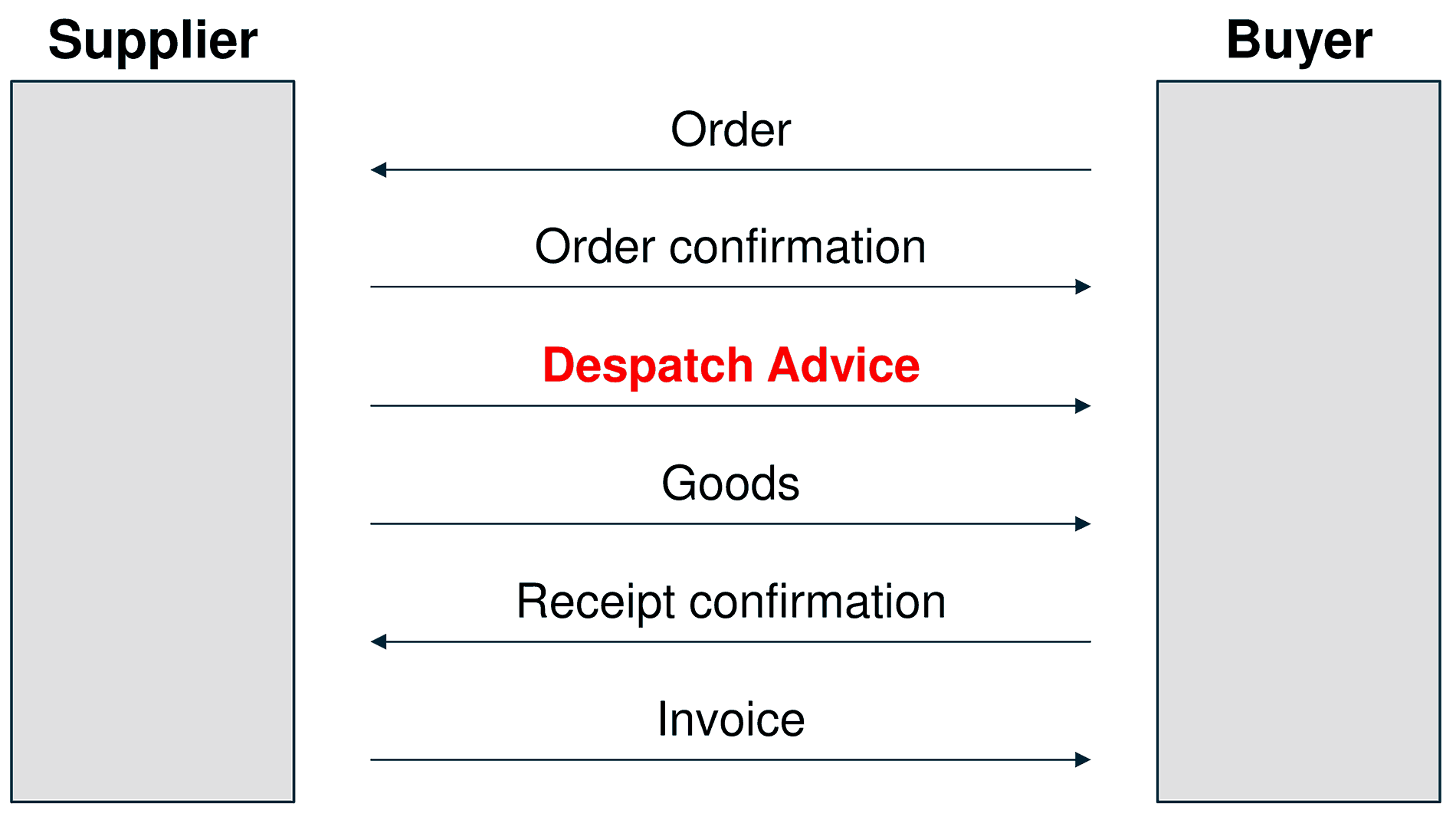
Sequence of electronic documents in a procurement process in the retail industry
What information does a DESADV contain?
The contents vary according to the EDI standard, industry and partner requirements. A DESADV commonly includes:
- The despatch advice and order reference numbers
- The supplier, customer and delivery location
- The despatch date and expected delivery date or time
- Product identifiers, such as Global Trade Item Numbers (GTINs)
- Quantities and units of measure
- The number and type of packages or logistic units
- Transport information where required
- Batch, lot, serial or best-before information where relevant
- SSCCs for individually identified logistic units
A DESADV can also describe the hierarchy of a shipment. For example, it can show which products and cartons are placed on a particular pallet. This structure becomes especially useful when each logistic unit has an SSCC.
What is an SSCC?
SSCC stands for Serial Shipping Container Code. It is an 18-digit number used to identify a specific logistic unit, such as a pallet, parcel or carton.
A GTIN identifies a type of trade item. An SSCC, by contrast, identifies one particular logistic unit. Two pallets containing the same products therefore need different SSCCs.
The SSCC is normally encoded in a barcode on a GS1 logistic label attached to the unit. Scanning the label enables the recipient to connect the physical pallet or parcel with the electronic information sent in the DESADV.
For a closer look at the code and how it is generated, read our guide to SSCC numbers.
How do DESADV and SSCC work together?
Combining DESADV and SSCC connects the digital flow of information with the physical flow of goods.
A typical process works as follows:
- The supplier prepares the shipment and creates a unique SSCC for each logistic unit
- The supplier adds the SSCC to the appropriate GS1 logistic label
- The supplier includes the same SSCC in the DESADV, together with details of the goods assigned to that unit
- The customer receives the DESADV and makes the information available to its warehouse or ERP system
- When the delivery arrives, a warehouse employee scans the SSCC label
- The system uses the SSCC to retrieve the expected contents and compare them with the goods received
Consider a delivery containing three pallets. Each pallet has its own SSCC, while the DESADV specifies which cartons and products belong to each pallet. Rather than entering every line manually, the receiving team can scan each pallet and access the corresponding shipment data.
According to GS1 guidance, this combination supports reliable traceability and faster receiving because the SSCC on the logistic unit matches the SSCC in the electronic despatch advice.
What are the benefits of using DESADV with SSCC?
Faster goods receipt
Advance shipment data helps the recipient prepare before the vehicle arrives. When the physical units carry SSCC labels that match the DESADV, warehouse teams can retrieve delivery information by scanning the relevant unit instead of entering it manually.
Fewer manual errors
Automated transfer and barcode scanning reduce the need to rekey order, product and packaging data. The recipient can compare the expected shipment with the units that arrive and investigate differences earlier.
Better traceability
A unique SSCC links a physical logistic unit with the relevant electronic data. This makes it easier to track a pallet or parcel through warehouse and transport processes.
Clearer packaging information
The DESADV can show how products, cartons and pallets relate to one another. This helps the recipient understand the shipment structure and process individual logistic units correctly.
More efficient planning
Knowing what is due to arrive and when helps receiving teams plan dock capacity, storage locations and internal resources. The quality of this planning depends on the accuracy and timing of the DESADV.
Common DESADV and SSCC implementation issues
The benefits depend on accurate, consistent data across the supplier’s system, the EDI message and the physical label. Common sources of difficulty include:
- Different SSCCs in the message and on the label: the recipient can’t reliably connect the physical unit with the expected data
- Incorrect packaging hierarchy: products are assigned to the wrong pallet, carton or package level
- Duplicate SSCCs: a code intended to identify one logistic unit is reused incorrectly
- Quantity or unit mismatches: the DESADV doesn’t match the shipment or the original order
- Late messages: the DESADV arrives after the goods, leaving no time for advance planning
- Incomplete master data: product, location or partner identifiers don’t match the recipient’s records
- Partner-specific rules being overlooked: the message may be technically valid but still fail the recipient’s agreed implementation requirements
Testing should cover the complete process, including data creation in the ERP or warehouse management system, EDI mapping, transmission, barcode generation and scanning at the receiving location.
How can businesses implement DESADV successfully?
Start with the business process rather than the message format alone.
- Agree the scope with each trading partner: define when the DESADV must be sent, which data is mandatory and which packaging levels need to be represented
- Check source data: confirm that the ERP or warehouse system holds the product, quantity, location and packaging information required for the message
- Define SSCC ownership and generation: make sure each logistic unit receives a unique code and that the same value reaches both the label and the DESADV
- Map and validate the message: transform the source data into the required DESADV version and test it against the partner’s rules
- Test the physical process: confirm that labels can be scanned and matched with the electronic shipment data at goods receipt
- Monitor ongoing exchanges: detect rejected, delayed or incomplete messages before they disrupt receiving processes
A technically correct message alone isn’t enough. The electronic data, physical labels and operational process must all remain aligned.
Conclusion
DESADV and SSCC serve distinct roles in the delivery process. A DESADV provides advance information about an incoming shipment, while an SSCC uniquely identifies a pallet, parcel or carton.
Used together, they link electronic shipment data to individually labelled logistic units. When the same SSCC appears in the DESADV and on the physical unit, the recipient can scan the delivery, retrieve its expected contents and process it with less manual work.
The result is a clearer connection between ordering, despatch and goods receipt, provided the message data, packaging hierarchy and labels are accurate.
More questions about DESADV?
You have further questions in regard to DESADV? You would like to use DESADV messages with a customer or supplier of yours? Please contact us – we’re more than happy to help!
FAQs
What does DESADV stand for?
DESADV stands for despatch advice. It is an EDI message that gives a customer advance information about an incoming delivery.
Is a DESADV the same as an ASN?
They serve the same core purpose. DESADV is the message name commonly used in EDIFACT and EANCOM®, while advance shipping notice (ASN) is a broader term used in other EDI standards and industries.
Is a DESADV the same as a delivery note?
A DESADV communicates delivery information electronically before or when goods are despatched. A paper delivery note may accompany the physical shipment. The two can contain similar information, but the DESADV supports system-to-system processing.
What is the difference between an SSCC and a GTIN?
A GTIN identifies a type of trade item, while an SSCC identifies one specific logistic unit, such as an individual pallet or parcel.
Does every DESADV require an SSCC?
Not necessarily. The required content depends on the agreed EDI implementation and trading partner requirements. SSCCs are particularly useful when individual logistic units need to be identified and matched with their contents.
When should a DESADV be sent?
It is normally sent after the shipment has been prepared and before the goods arrive. The precise timing should be agreed with the receiving trading partner.