



For many years Norway has been leading the way when it comes to e-invoicing legislation. Compared to the other European countries required to implement regulations to meet EU Directive 2014/55/EU, Norway has achieved impressive results – with e-invoicing now extremely widely used in the country across both B2B and B2G transactions.
In this article we look at the current state of e-invoicing in Norway and what you need to do to ensure you are able to exchange automated electronic invoices with Norwegian partners.
But before we start examining the current state, let’s have a brief look into the past and the e-invoicing developments in Norway.
The growth of e-invoicing in Norway
2011
Since 2011 central Norwegian bodies have been required to be able to receive e-invoices from suppliers.
2012
In 2012 it became mandatory for partners of central Norwegian bodies to send only structured electronic invoices. By passing this legislation in 2012 Norway cemented itself as one of the most forward-thinking countries in Europe with regards to e-invoicing. Indeed, this legislation was passed two years prior to Directive 2014/55/EU, which in turn didn’t require countries to implement similar regulations until April of 2018.
2019
On 1 April 2019 regulation FOR-2019-04-01-444 relating to electronic invoicing in public procurement was passed. This made it mandatory for non-central Norwegian public bodies to be able to receive and process e-invoices. Since this date suppliers of non-central public bodies have also been required to send only structured electronic invoices. Further, those e-invoices sent must conform to the EU Norm, using either EHF or the Peppol BIS standard (in addition to being sent via the Peppol eDelivery network). Similarly, all central government bodies issuing invoices themselves must also ensure their invoices conform to these standards.
2020
There is now a monitoring system in place to track the use of e-invoicing with central and non-central public bodies. Currently around 90% of all invoices sent to Norwegian public entities are e-invoices.
E-invoicing standards in Norway
Norway has implemented the European e-invoicing standard EN 16931, which has been reconciled with the pre-existing Norwegian E2B standard.
EHF (Elektronisk Handelsformat) and Peppol BIS (Business Interoperability Specification) are the two document formats that Norwegian public bodies must be able to receive. Both are based on UBL (Universal Business Language). In order to receive Peppol BIS messages all that is required is a connection to a Peppol access point provider. To accept EHF invoices receivers must be registered with ELMA (Elektronisk mottakaradresseregister).
EHF is used exclusively between Norwegian organisations. Meanwhile the more popular Peppol BIS format is used for both cross-border and national transactions, with CEF Digital estimating that the Peppol format is currently used by approximately 99% of contracting authorities.

How to send e-invoices in Norway
Thankfully, compared to other European countries, many of which have complicated e-invoicing regulations due to complex federated legal landscapes, sending e-invoices in Norway is fairly simple.
Helpfully, as already mentioned, Norwegian eProcurement relies heavily on Peppol and is dependent on both the Peppol BIS 3.0 standard and the Peppol eDelivery Network – particularly for cross-border transactions. As a result, those looking to achieve compliance with Norwegian regulations simply need a connection to a Peppol access point provider (such as ecosio). Due to Peppol’s four corner delivery model (pictured below) suppliers do not need to establish point-to-point connections to partners or use the same provider as prospective partners. Rather, all transactions can be handled through a single provider. Meanwhile, the fact that all Peppol connected companies have to use the same standards helps to drastically reduce the work (and time) required to establish new partner connections.
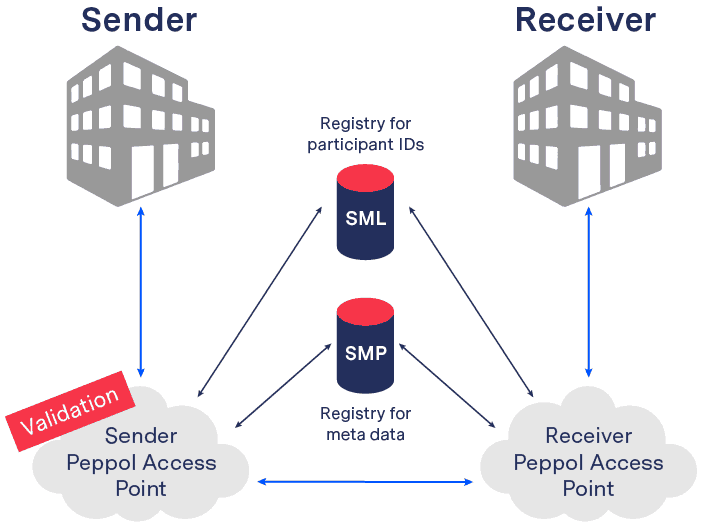
To help businesses understand the technical requirements, the Norwegian Digitalisation Agency has created a reference directory for IT standards in the public sector (“Referansekatalogen for IT-standarder i offentlig sektor”) which can be found on the Digdir website.
Norwegian e-invoicing requirements at a glance
| STANDARDS | IS E-INVOICING MANDATORY? | METHODS OF SENDING |
|---|---|---|
|
Suppliers of central bodies: YesSuppliers of non-central bodies: Yes |
|
What is the future of e-invoicing and EDI in Norway?
As elsewhere across Europe, the relatively recent requirement for suppliers of public Norwegian bodies to be able to send e-invoices is likely to have knock-on effects on B2B supply chains too. As more and more businesses gain the ability to send structured electronic invoices, it is highly likely that many will want to benefit from automated message exchange with all of their partners and across an increasing number of business processes. In turn, as more companies gain EDI (electronic data interchange) capability in order to achieve the associated cost savings, such capability is likely to become an increasingly essential cog in successful supply chains.
Want more information on e-invoicing in Norway?
At ecosio we are experts in e-invoicing and electronic data interchange. Over the years we have helped thousands of businesses to streamline their supply chain and improve key processes, all while minimising pressure on internal teams.
For more information on how we can help you meet e-invoicing regulations in Norway and for advice on what practical steps you can take towards automation please contact us today. We are always happy to answer any questions.
You may also be interested in our blog articles on e-invoicing in…
Are you aware of our free XML/Peppol document validator?
To help those in need of a simple and easy way to validate formats and file types, from CII (Cross-Industry Invoice) to UBL, we’ve created a free online validator.