


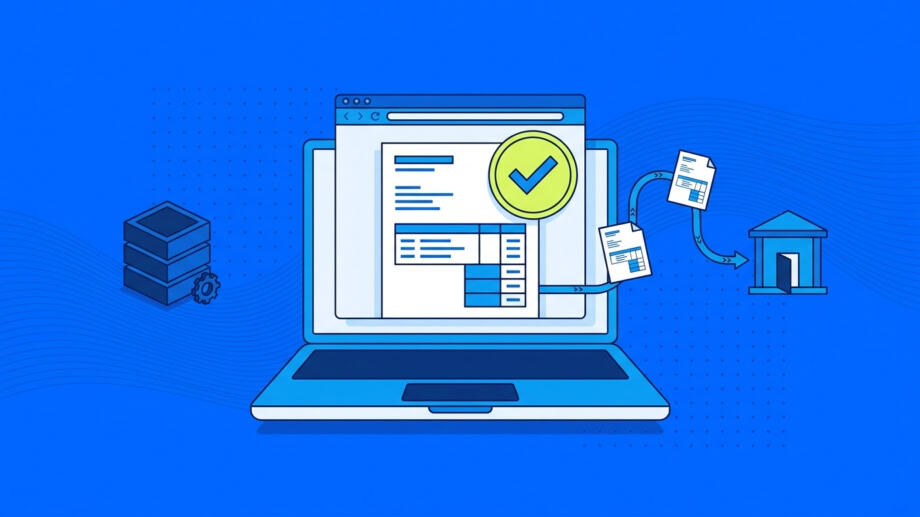

Integrating your enterprise resource planning (ERP) system is the right end goal for e-invoicing, and for most of your invoice volume it’s the only sensible one. The difficulty is that large groups often have invoices sitting outside that. Some belong to flows where the integration won’t be live before the mandate deadline. Others come from smaller legal entities with no ERP to integrate in the first place. E-invoicing without ERP integration is how you keep both compliant, without slowing down the automation you actually want.
TL;DR
- Integration remains the goal wherever the invoice volume justifies it.
- The mandate date doesn’t move, but the date your organisation can start is not fixed in the same way.
- Compliant invoicing doesn’t have to wait for an ERP integration to finish.
- Compliance mode lets your finance team create, validate and submit mandate ready invoices in the browser.
- Low volume entities and entities with no ERP can be compliant without a project of their own.
- Mandate obligations apply entity by entity, including the entities too small to integrate.
- Covering the deadline now and automating later is a sequence that works in your favour.
Why starting early isn’t always an option
Most compliance plans are sequential. You scope the work, integrate your ERP, test, and only at the end of that chain can you send a compliant invoice. Compliance becomes an output of the project.
The weakness is easy to miss. That model ties your compliance date to the date your own organisation can get an integration programme approved and started. Only one of those two dates is set by law.
Plenty of things decide when that programme can start, and most of them sit outside the finance team. Detailed guidance on scope and formats often arrives late, so you see the full requirement only after the budget is already set. An acquisition brings entities into scope that were not in the plan when it was written. A country you sell into moves from voluntary to mandatory. Spending approval follows your internal calendar, not the tax authority’s.
The impact isn’t partial. If the work cannot realistically be finished before the deadline, you’re not slightly behind, you’re non compliant. Invoices get rejected, payments stall, and your finance team absorbs rework it didn’t plan for.
That’s why teams who are not ready for an e-invoicing mandate often feel they only have bad options. Narrow the scope of the integration and carry the risk of everything left out of it. Accept that the deadline will pass before the work is done and carry the exposure. Or buy a cheap local tool for one entity and inherit a second system nobody owns.
The cost of getting it wrong varies by country and by which rule you break, but every mandate carries one. A few examples of what is already on the books:
- Germany: up to 5,000 EUR per offence under §379 AO (Abgabenordnung, the German Fiscal Code) for late, incorrect or missing submission of a mandated e-invoice, with the issuance obligation phasing in from 1 January 2027 for businesses above 800,000 EUR turnover and covering everyone from 1 January 2028.
- Norway: the tax administration can issue a bookkeeping order and then daily coercive fines (tvangsmulkt) of 1,345 NOK per day, capped at 1,000,000 NOK, ahead of the 1 January 2027 issuance deadline.
- Greece: issuing an invoice outside the prescribed e-invoicing channels is treated as not issuing an invoice at all, which triggers the penalties that come with non-issuance under the Tax Procedure Code.
- France: under the draft Finance Law for 2026, and subject to its adoption, invoice errors carry a fine of 50 EUR per error or omission, failure to receive e-invoices carries graduated fines of up to 1,000 EUR every three months, and e-reporting failures cost 500 EUR per missing transmission, capped at 15,000 EUR a year. First offences and promptly corrected ones are exempt.
There is a commercial cost alongside the regulatory one. A non-compliant invoice is rejected by your customer’s system, which delays payment, and in some countries it puts your customer’s input VAT deduction at risk. That makes it their problem too, which is rarely good for the relationship.
There is also a reason to separate compliance from integration that has nothing to do with being behind. Time pressure is how companies end up with a provider they would never have chosen with more time to think: whatever could go live quickest, built for one country, owned by nobody in particular. Taking the deadline out of the decision means you can run the evaluation you meant to run, and set e-invoicing up the way you want to work, rather than the way the calendar allowed.
There’s a better way to think about it. Ask whether compliance has to depend on the integration at all. Once you separate the two, the deadline stops being a project risk and becomes something you can cover on its own, while the integration carries on to the timeline it needs. The same separation applies to the entities that will never justify an integration, which is the second half of this article.
What e-invoicing without ERP integration actually looks like
The usual assumption is that a mandate-ready invoice can only come out of an integrated system, because the invoice has to carry specific structured data and reach the tax authority in a specific way. For most finance teams that knowledge sits outside their skill set, so the whole thing waits on IT.
The impact is a bottleneck in the wrong place. The people who understand the invoice can’t produce a compliant one, and the people who can are busy with the integration.
Compliance mode in Flow, our online e-invoicing portal, removes that dependency. The compliance layer sits with your provider rather than inside your ERP project. Your accounts receivable team creates the invoice in the browser, or uploads an invoice file so every field prefills, then edits or adds anything the source system couldn’t provide. On submission, compliance mode checks the invoice against the mandate rules before it goes any further. Nobody touches XML or EDI.
Here’s the comparison that matters:
- Without compliance mode, your compliance date is whatever your project date turns out to be.
- With compliance mode, you meet the mandate as soon as your team is set up, and the integration continues on its own timeline.
To be clear about what this is and isn’t: for the volume that justifies automation, compliance mode doesn’t replace the integration. It gives the integration the room to be scoped and tested properly, rather than being squeezed to fit a date, and manual creation stops as soon as the automated flow goes live. With ecosio, both run on the same platform, so nothing you set up in compliance mode is wasted when that happens.
So for most of your business, compliance mode is a temporary e-invoicing solution, and that’s exactly what it should be. For one part of your business, it isn’t temporary at all.
The entities that will never be integrated
Ask a finance director how many legal entities issue invoices, then ask how many of those will realistically ever be integrated. The gap is usually wider than anyone expects.
Inside most groups there’s a long tail the business case never reaches. A site issuing a handful of invoices a month. A newly acquired company running on a system nobody intends to keep. A service entity with no ERP to integrate at all. Running an integration project for each of them would cost far more than it ever returns.
The impact is that mandate obligations apply entity by entity. If one entity is in scope and not ready, that entity is exposed, however well prepared the rest of the group is. Gaps like this usually show up in an audit rather than at go-live.
None of that is an argument against integration. It’s an argument for putting integration where it pays back, and having a compliant route for everything else instead of pretending the tail doesn’t exist.
So treat those entities as a design decision rather than an exception. For them, e-invoicing without ERP integration is the end state rather than a stopgap. They’ll use compliance mode permanently, on the same platform as the entities that are fully integrated. That’s what makes group-wide e-invoicing compliance realistic rather than aspirational, and it’s why e-invoicing for subsidiaries and e-invoicing for low-volume entities are worth planning deliberately. Exceptions are what turn into audit findings later.
Manual entry, without the manual risk
There is a fair objection to all of this. Manual means human, human can make mistakes, and mistakes are exactly what mandates punish. A wrong VAT identifier or a missing mandatory field is the difference between an invoice that clears and one that comes back, and nobody wants to hand that risk to a team already under pressure.
That objection assumes compliance mode is a blank form, and it isn’t. Every invoice is checked against the rules for that country before it is submitted: mandatory fields, code lists, identifiers, totals and format. Anything that fails is flagged while the invoice is still open and editable, in language the person in front of it can act on.
Compare that with what happens when an invoice leaves an unprepared system. It goes out, a rejection comes back some days later, and finance works backwards from an error code to find out what was wrong. In the meantime the invoice is unpaid, the customer is chasing, and in some countries the clock on your obligation is still running. The error was always there. The only variable is whether you found it or the tax authority did.
A few other things cut the risk down further:
- Uploading an invoice file prefills the fields, so far less is typed by hand in the first place.
- Rules are maintained by your provider, so when a country changes a requirement your team doesn’t have to notice, interpret and implement it.
- Anything your source system can’t supply is added in compliance mode before submission, including attaching a PDF to the invoice, so a gap in your ERP doesn’t turn into a compliance problem.
No provider can promise that a tax authority will accept every invoice, and anyone who does is overselling. What compliance mode changes is where errors get caught, who can fix them and how long that takes. For the entities that will always invoice this way, that difference is permanent, and adding a new one stops being a project request and becomes an onboarding step.
How to tell whether this fits your organisation
Work through the checklist below. If you answer yes to two or more, compliance mode is worth evaluating.
- Is there a gap between your mandate deadline and your realistic integration go-live date?
- Do you have legal entities that issue invoices but will never justify an integration?
- Do any of your entities have no ERP to integrate?
- Does your ERP struggle to produce everything the mandate requires?
- Would a rejected invoice be spotted by your team, or by the tax authority?
- Is anyone in finance expected to understand invoice formats to stay compliant?
The wider direction of travel makes this more pressing rather than less. The European Commission’s VAT in the Digital Age package sets out a shift towards structured, near real time reporting as the default, which means the number of entities in scope inside a typical group will keep growing.
Integration is still where you want to end up, and starting early is still the best way to get there. But if the timing wasn’t yours to control, you’re not out of options. You can meet the e-invoicing deadline now and still build the long term setup you actually want.
Learn more about how ecosio supports group-wide e-invoicing compliance, whatever stage your integration is at.
FAQs
Can I use e-invoicing without ERP integration?
Yes. A browser-based e-invoicing portal lets your finance team create, validate and submit structured invoices without connecting an ERP system. The solution must support the requirements of the relevant country and invoice flow.
What if my ERP integration won’t be ready before the e-invoicing deadline?
A browser-based solution can bridge the gap while your integration project continues. With compliance mode in ecosio Flow, your team can create and submit invoices manually, then move to automated invoicing once the integration is live.
Is e-invoicing without ERP integration only a temporary solution?
No. It can also be a permanent option for low-volume subsidiaries or legal entities with no ERP system. This lets you focus integration investment where automation delivers the most value, while maintaining a compliant invoicing route for smaller entities.
How does browser-based e-invoicing reduce manual errors?
Compliance mode validates invoice data against country-specific requirements before submission, flagging issues such as missing mandatory fields or incorrect totals. Uploading an invoice file also reduces manual typing. These checks help catch errors earlier, but do not guarantee acceptance by the recipient or tax authority.